
What New York State Tourism is Missing
Fragmented Destination Marketing Organizations (DMOs), limited capacity, and a focus on international visitors are leaving the domestic drive market behind. To demonstrate this gap, Rural Tourism Network surveyed over 170 New York City-area residents about their awareness of Upstate New York and its tourism offerings.
Why We Ran This Survey
Working with destination marketing organizations, attending tourism conferences, reading the research; there is a clear pattern: the conversation is often focused on international visitors.
And there is a reason for this. International visitors to New York City represent roughly 20% of arrivals but close to 50% of total visitor spending. They stay longer, spend more per day, and generate outsized economic impact. The industry has invested accordingly; multilingual content, overseas marketing partnerships, global distribution channels, and international press trips.
While the industry looks outward, Rural Tourism Network noticed something closer to home: a real gap in awareness amongst domestic travelers about tourism offerings in their own states and regions. Upstate New York is surrounded by tens of millions of people within a few hours' drive of some of the most compelling landscapes, heritage sites, and trail networks in the country. They are in Buffalo, Syracuse, Pittsburgh, Cleveland, and New York City. They are already traveling, but most of them have no idea what's within reach.
We wanted to understand how deep that knowledge gap actually ran. So we surveyed the market closest to us.
New York City
New York City is a microcosm of the domestic traveler.
The city holds long-term residents who have lived in the same borough for decades. Students who arrived six months ago and are seeing the Northeast for the first time. International residents who have built their lives here and are exploring the country they now call home. Families across a wide range of incomes, travel styles, and preferences. Young professionals making spontaneous weekend decisions. Retirees planning deliberately. Solo travelers, group travelers, and everyone in between.
You are not just surveying New York City, you are capturing a cross-section of the domestic drive market at its most diverse. The findings reflected that range and they were striking across the board.
What We Found
We asked respondents about specific Upstate New York assets and whether they were aware of them. The gaps were significant:
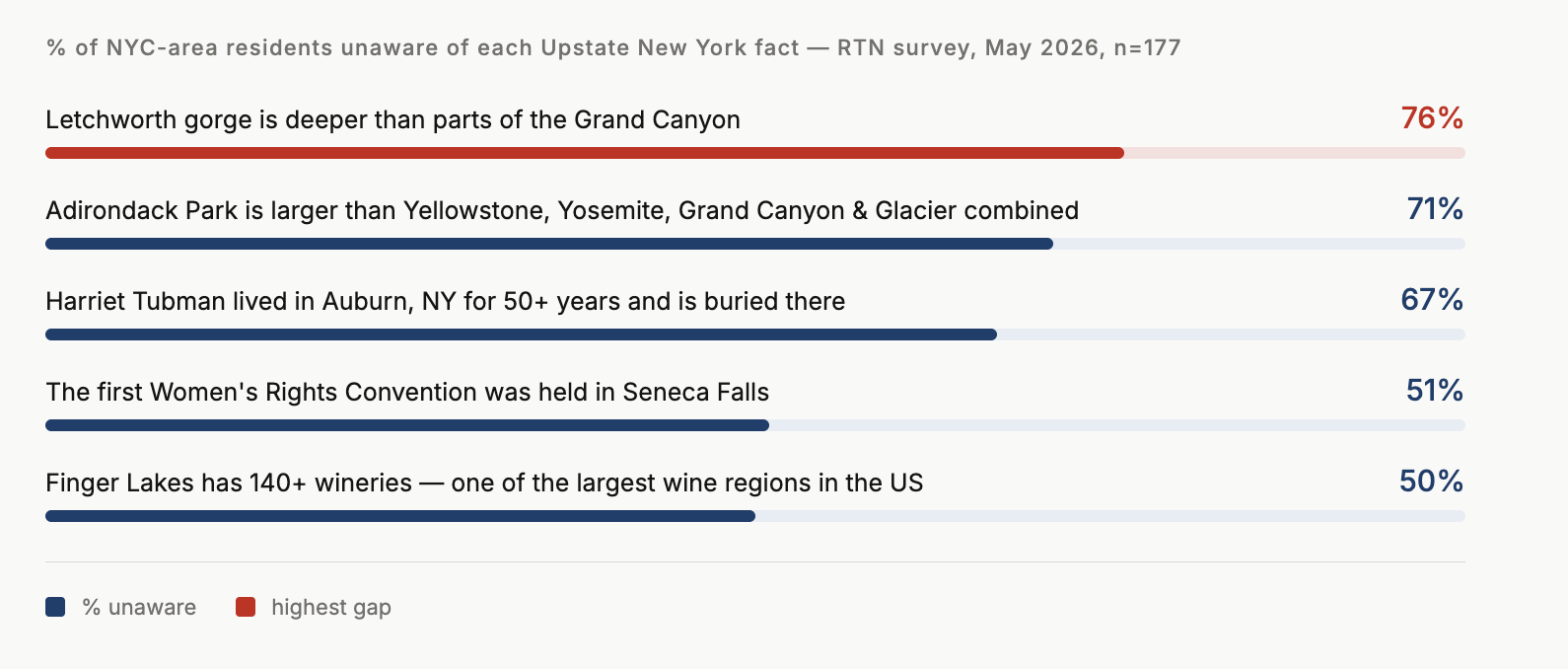
These are the defining stories of this region, yet most New Yorkers couldn't place them. The gaps extend to specific destinations as well:
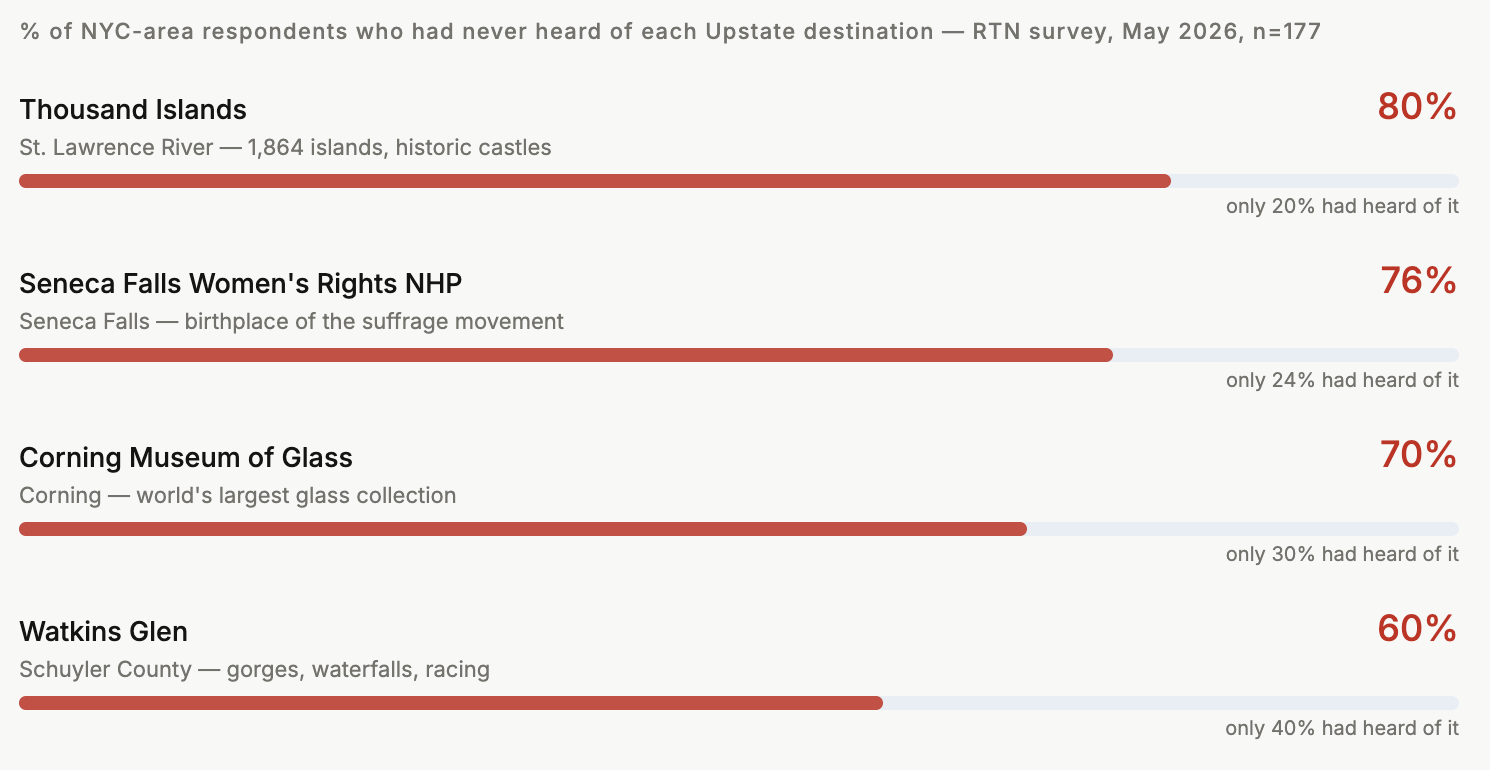
These are anchor attractions in established regions, within a few hours of one of the world's most visited cities. Upstate New York doesn't have a quality problem. It has a visibility problem.
Awareness Is Only Half the Story
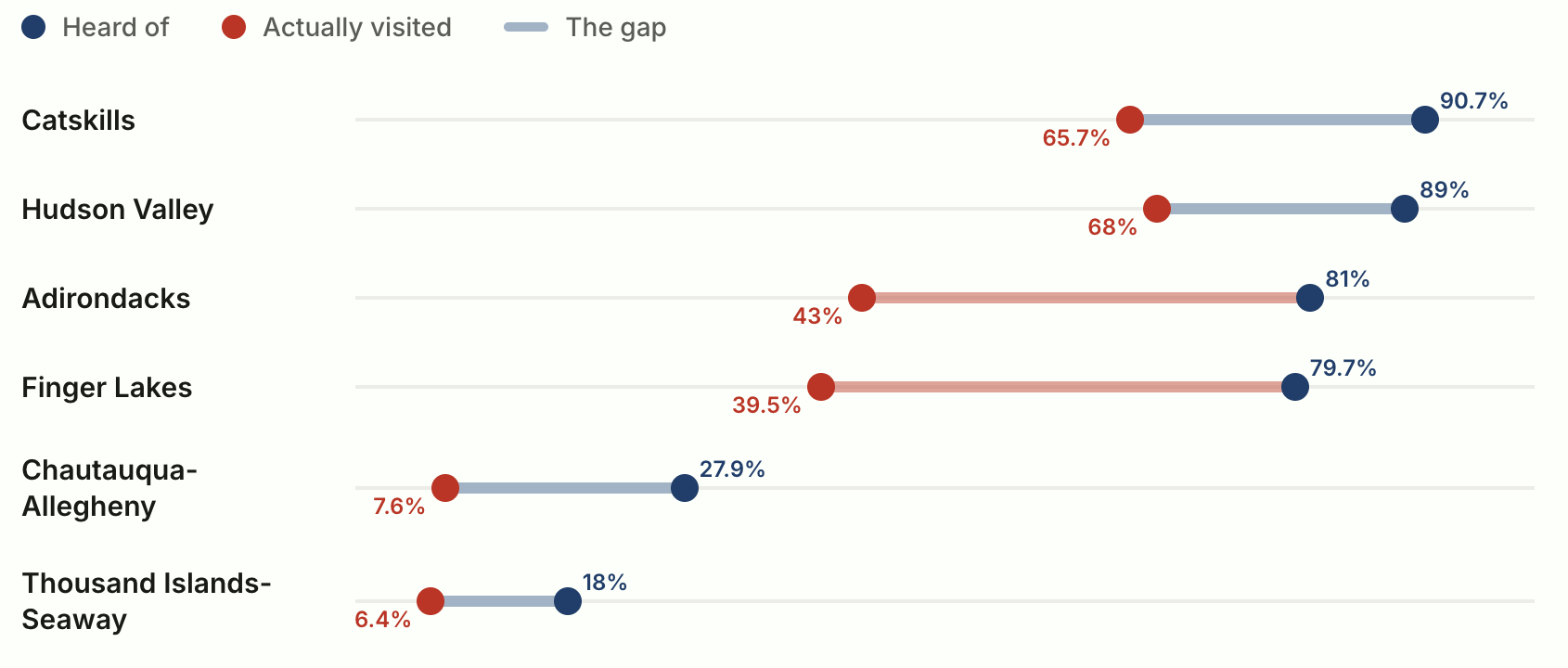
The survey also asked which Upstate regions respondents had heard of versus actually visited. The gap between the two tells a more nuanced story.
The Catskills and Hudson Valley dominate on both measures: 90.7% and 89% awareness, 65.7% and 68% visitation. Proximity to New York City and decades of cultural attention have done their work.
Further afield, the picture shifts. The Adirondacks registered 81% awareness, nearly as high as the Catskills, yet only 43% of respondents had ever visited. The Finger Lakes show 79.7% awareness and only 39.5% visitation. People have heard of these places, but they aren’t visiting.
Then there are the regions that barely register at all. Chautauqua-Allegheny: 27.9% awareness, 7.6% visitation. Thousand Islands-Seaway: 18% awareness, 6.4% visitation. The Capital Region, home to Albany and Saratoga Springs, sits at 29.7% awareness despite being less than three hours from the city.
Two distinct problems live inside these numbers. For the Adirondacks and Finger Lakes, the challenge is conversion: awareness exists, but something is preventing the trip. For Chautauqua, the Thousand Islands, and much of Central New York, the challenge is discovery: people simply don't know these places exist. A platform built for the domestic drive market has to solve both.
New Yorkers Already Make These Trips
One persistent assumption in rural tourism is that distance is the barrier. We don’t agree.
New Yorkers drive to the Hamptons in 2 to 3 hours, closer to four in summer traffic. Cape Cod is a 4-hour drive. Newport is 3 hours. The Berkshires are 3 to 3.5 hours. These destinations fill up every Friday afternoon, with accommodation prices to match.
The Finger Lakes are 4.5 to 5 hours from New York City, the same distance as Cape Cod, with 140+ wineries, glacially carved lakes, gorges, and waterfall trails. Letchworth State Park is under an hour from Rochester and under six hours from Pittsburgh. The Adirondacks are less than five hours from Midtown.
The drive market isn't asking anyone to travel farther than they already go. It is asking them to go somewhere different. That is a content and awareness challenge, not a logistics one.
New York State set tourism records in 2024: 315 million visitors and $94 billion in direct spending. But within that growth, awareness and economic impact remain unevenly distributed. The Catskills and Hudson Valley capture a disproportionate share of the drive market's attention. The rest of Upstate, with equal or greater assets, is largely missing from the consideration set.
The survey asked what would actually move NYC-area residents to book a trip upstate. The answers pointed toward content, not campaigns:
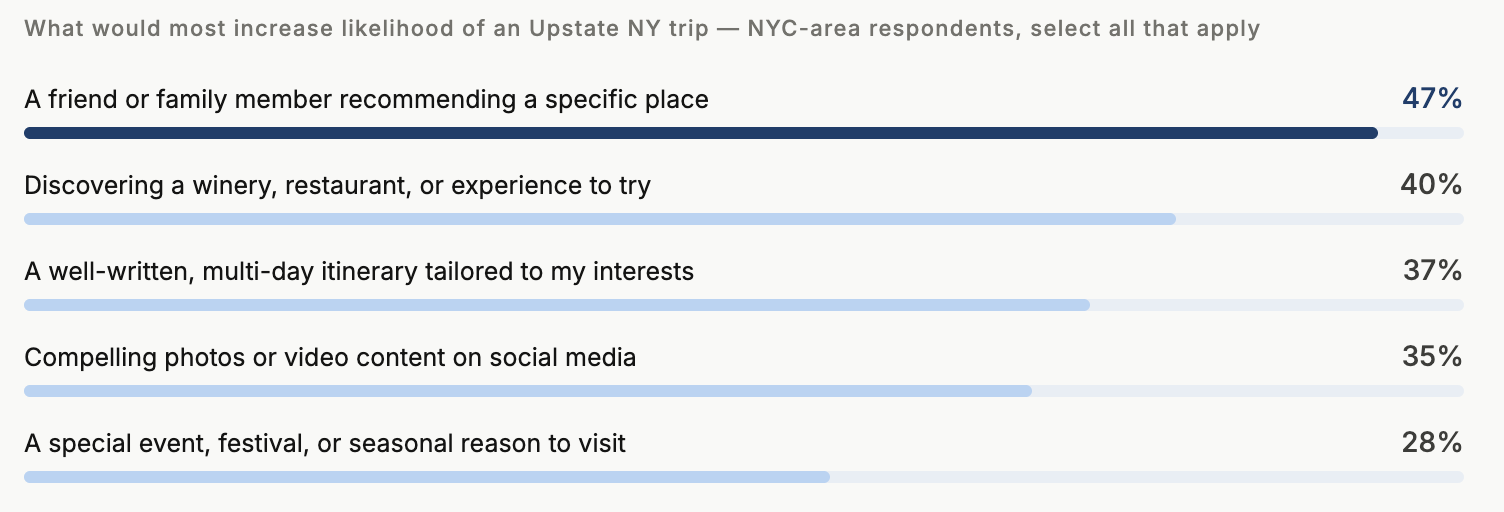
The same opportunity extends well beyond New York City. Pittsburgh, Cleveland, and Columbus sit within range of the Finger Lakes and the Southern Tier. Buffalo and Syracuse are under two hours from half a dozen distinct Upstate regions. Toronto is a comfortable day trip to the Thousand Islands. The domestic drive audience for Upstate New York is enormous, geographically distributed, and largely untapped.
Why the Gap Exists and Why It Persists
The knowledge gaps are the predictable outcome of a tourism infrastructure that was never designed to serve rural destinations at scale.
Upstate New York's tourism ecosystem is fragmented by design. Destination Marketing Organizations (DMOs) operate county by county, each with their own budget, board, and mandate. Collaboration across county lines is difficult: politically, logistically, and financially. The organizations that are best positioned to tell the story of a region often can't, because the region doesn't have a single voice. Rural DMOs compound this with a capacity problem. Our research across 68 organizations in 16 states found that 79% report growing visitation, while 69% cite staff capacity as their top barrier. Many Upstate DMOs operate with teams of two or three people managing everything from event coordination to social media to partner relations. Unified marketing, the kind that builds regional awareness across an entire drive market, simply isn't achievable at that scale without shared infrastructure.
At the state level, the incentives point elsewhere. New York City generates the majority of the state's tourism revenue and attracts the lion's share of international visitors. A state-level DMO focused on economic impact will, rationally, prioritize its highest-performing markets. The result is that smaller communities and rural regions receive a fraction of the marketing investment relative to their assets, and domestic travelers, who don't need a visa or a transatlantic flight, are consistently underleveraged.
The low awareness numbers in this survey are a symptom of all three. Fragmented organizations. Understaffed teams. A promotional ecosystem that focuses its energy on international visitors and marquee destinations while the regional drive market goes largely unaddressed.
Why We Built Upstate
Upstate (upstatebound.com) is Rural Tourism Network's response to that structural problem, a unified discovery platform that gives rural DMOs a way to participate in regional marketing without requiring them to build it themselves.
The platform is designed around the reality of how rural DMOs actually operate. Organizations can participate at whatever level fits their capacity, including a free membership tier. A two-person DMO gets the same regional visibility as a larger organization, because the infrastructure is shared. Trails, regions, and operators across county lines appear in the same discovery layer, creating the unified presence that no single organization could sustain on its own.
For travelers, it means finding the Finger Lakes, the Thousand Islands, Chautauqua, and Central New York in one place; with itineraries, trail maps, and operator listings that make the trip easy to plan. For DMOs, it means domestic drive market exposure they couldn't generate independently. For communities that have been consistently underrepresented in New York State's tourism promotion, it means finally having a seat in the conversation.
We ran this survey to show DMOs what the data confirms: the domestic drive market is large, it is within reach, and it does not know what's here. The knowledge gaps are real. The opportunity is real. And the platform exists specifically to close both.
What Comes Next
Upstate launched earlier this year, with the Finger Lakes as the first full region on the platform; itineraries built around wine trails, heritage routes, outdoor corridors, and the communities that hold them together.
If you work in rural tourism, destination marketing, or regional economic development in New York State or beyond, Rural Tourism Network would welcome the conversation.
